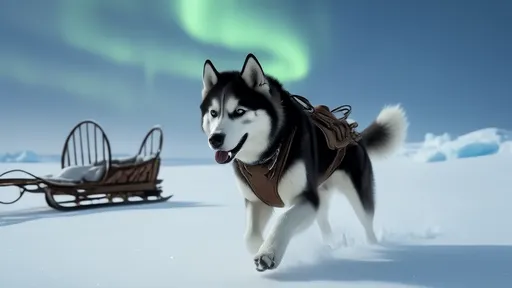
The Siberian Husky, with its piercing blue eyes and wolf-like appearance, is far more than a striking companion animal. Beneath that charismatic exterior lies a legacy forged in ice, a history written in the relentless winds of the Arctic. This is not merely the story of a breed, but the chronicle of a partnership between humans and dogs that conquered one of the most unforgiving environments on Earth, a partnership built on endurance, intelligence, and an unbreakable spirit.
The origins of the Siberian Husky are deeply intertwined with the Chukchi people of northeastern Siberia. For centuries, perhaps millennia, the Chukchi depended on these medium-sized, resilient dogs for their very survival. Life on the stark, frozen tundra demanded a unique set of traits, and the Chukchi, through careful and selective breeding, cultivated them. Theirs was a practical, not an aesthetic, pursuit. They needed dogs that could pull light loads over vast distances with incredible efficiency, dogs that could thrive on minimal food in sub-zero temperatures, and dogs whose cooperative nature meant a sled team could function as a harmonious unit rather than a pack of rivals. The resulting canine was the progenitor of the modern Husky: hardy, energetic, and possessing an almost supernatural stamina.
The primary role of these early Huskies was transportation and communication. In a landscape where horses would perish and technology was useless against the deep cold, the dog sled was the Chukchi's lifeline. Teams would transport hunters to sealing and fishing grounds, carry goods for trade between villages, and, most importantly, maintain the social and familial bonds that held the community together across the vast, empty distances. The dogs were not seen as mere beasts of burden but as integral members of the family. They were often allowed inside the nomads' tents to sleep with the children, providing warmth and companionship. This close coexistence fostered the breed's famous friendly and gentle temperament towards people, a trait that remains a hallmark today.
The world outside of Siberia remained largely unaware of this exceptional sled dog until the early 20th century, when the thirst for gold and adventure thrust them into the international spotlight. The Alaskan gold rushes created a massive demand for reliable winter transportation. While larger freighting dogs like the Alaskan Malamute were used for hauling heavy loads over short distances, there was a need for speed and endurance for the long hauls, particularly for the All-Alaska Sweepstakes, a grueling 408-mile sled dog race from Nome to Candle and back. Mushers began importing these "Siberian rats," as they were sometimes dismissively called for their smaller size compared to the local breeds, to compete.
Their performance was nothing short of revolutionary. In 1909, a driven fur trader and musher named William Goosak brought a team of Siberians to Nome. Despite being mocked for their stature, his team’s speed and spirit turned heads. The following year, a larger contingent was brought over, and in 1910, John "Iron Man" Johnson and his team of Siberians shattered all records in the Sweepstakes, completing the course in a time that was considered impossible. This victory proved decisively that the Siberian Husky's endurance and efficiency far outweighed any advantage of brute strength. They were the perfect distance athletes.
However, the single event that cemented the Siberian Husky's place in history and legend was the 1925 serum run to Nome, also known as the "Great Race of Mercy." A deadly diphtheria epidemic threatened to wipe out the isolated town of Nome. The only serum was in Anchorage, nearly a thousand miles away. Aircraft could not fly in the brutal weather, and the railroad only reached Nenana. The only hope was a relay of the best mushers and their dog teams across 674 miles of the most treacherous terrain Alaska could offer, in the heart of winter with temperatures dipping to -50°F and gale-force winds.
The relay was a feat of unimaginable courage and determination, but its success hinged on the dogs. The final leg, the most dangerous stretch across the shifting ice of the Norton Sound, was entrusted to Leonhard Seppala and his lead dog, Togo. Seppala’s team, comprised almost entirely of Siberian Huskies, ran an astounding 91 miles through a blinding blizzard, navigating the perilous ice to save time. As the ice began breaking apart behind them, they passed the serum to Gunnar Kaasen. Kaasen’s team, led by the famous Balto, fought through a whiteout so severe Kaasen could not see the dogs harnessed directly in front of him. Balto unerringly found the trail and finally delivered the lifesaving serum to Nome.
While Balto received the immediate fame (leading to a statue in New York's Central Park), it was Togo and Seppala's longer, more technically brilliant run that truly saved the day. This event showcased the breed's ultimate virtues: unwavering loyalty, incredible navigational instinct, and a heart that simply would not quit in the face of impossible odds. The serum run was the pinnacle of the Siberian Husky's working career, a testament to what they had been bred for over countless generations.
Following this heroic episode, the breed's popularity exploded across the United States and Canada. The American Kennel Club officially recognized the Siberian Husky in 1930. As their fame grew, they began to transition from indispensable working dogs to beloved show and companion animals. While this shift saved the breed from obscurity, it also inevitably began to dilute the very working traits that had defined it for so long. Show lines sometimes prioritized a specific look over the rugged athleticism of their Chukchi ancestors.
Yet, the call of the wild was never fully extinguished. The sport of sled dog racing, from local sprint races to epic long-distance challenges like the Iditarod Trail Sled Dog Race, keeps the working spirit of the Husky alive. Modern sled dogs are often a mix of breeds optimized for speed, but the core genetic contribution and the heart of the sled dog world remain deeply indebted to the Siberian Husky. Their DNA is the foundation upon which the sport is built. Furthermore, Huskies are still used for their original purpose by some Arctic communities and adventurous mushers who value their toughness and reliability in extreme conditions over pure speed.
The legacy of the Siberian Husky as an elite polar worker is etched into its very being. That intense energy that can be so challenging in a suburban backyard is the same energy that powered teams across hundreds of miles of frozen wilderness. That stubborn independence is a relic of the intelligence and problem-solving required to survive where humans often needed to follow the dog's lead. That strong prey drive was once essential for scavenging food in lean times. And that profound, almost silent communication within a pack is the direct descendant of the seamless cooperation required of a sled team fighting for survival against a storm. They are not just dogs with a history; they are living history, a beautiful, howling reminder of a time when our survival depended on the strength, heart, and loyalty of our four-legged partners.

By /Aug 20, 2025

By /Aug 20, 2025

By /Aug 20, 2025

By /Aug 20, 2025

By /Aug 20, 2025
By /Aug 20, 2025

By /Aug 20, 2025

By /Aug 20, 2025
By /Aug 20, 2025
By /Aug 20, 2025
By /Aug 20, 2025
By /Aug 20, 2025

By /Aug 20, 2025
By /Aug 20, 2025
By /Aug 20, 2025
By /Aug 20, 2025
By /Aug 20, 2025
By /Aug 20, 2025

By /Aug 20, 2025
By /Aug 20, 2025
