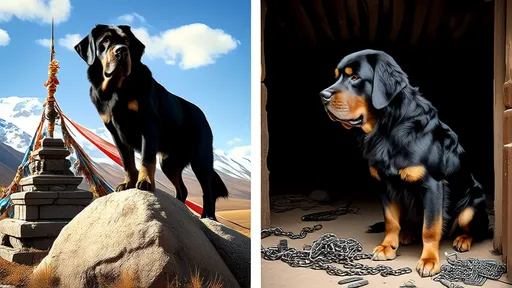
In the mist-shrouded highlands of Tibet, where the air thins and the mountains pierce the heavens, a legend was born. It was not a legend of gods or demons, but of a dog—a massive, lion-maned beast said to possess the strength to battle snow leopards and the loyalty to guard entire monasteries alone. This was the Tibetan Mastiff, a creature that would, centuries later, be catapulted from its sacred, isolated home into a whirlwind of global obsession, only to be cast aside when the myth inevitably shattered. Its story is not merely about the fluctuation of an animal's popularity; it is a profound parable of human desire, cultural appropriation, and the brutal economics of turning a living being into a status symbol.
The origins of the Tibetan Mastiff are as ancient and enigmatic as the plateau itself. For millennia, these dogs were not pets in any conventional sense. They were working partners to the nomadic tribes of the Chang Tang, indispensable guardians of flocks against wolves and bears. They were spiritual sentinels, keeping watch over remote Buddhist monasteries, their deep, resonant barks echoing through the valleys like sacred chants. To the outside world, they were little more than a traveler's tale, a magnificent rumor. Marco Polo himself, in the 13th century, wrote of encountering dogs in Tibet "as large as donkeys," a description that would fuel Western fascination for generations. This isolation preserved the breed, allowing it to develop its formidable characteristics—a thick, weather-resistant double coat, a powerful, muscular build, and a fiercely independent and protective temperament—untouched by the whims of foreign breeders.
The first cracks in this isolation appeared in the 19th century when a handful of these "great dogs of Tibet" were brought to England. Presented as exotic curiosities, they were crossbred with other large breeds, contributing to the foundation of many Western mastiff types but doing little to establish a purebred line. They remained a niche interest for dedicated canine enthusiasts. The true catalyst for the myth's inflation, however, was China's economic explosion in the late 20th and early 21st centuries. As newfound wealth flooded the nation, the country's elite sought novel ways to display their prosperity. What better symbol than a dog straight out of national myth and legend? The Tibetan Mastiff was reborn not as a working dog, but as a luxury item—a living, breathing declaration of affluence.
The mythmakers went to work with fervor. Marketing campaigns portrayed the dogs not just as protectors, but as spiritual assets, embodying the raw, untamed power of the Himalayas. They were dubbed "lion dogs" for their impressive manes, and their aloof, intimidating demeanor was sold as a sign of noble intelligence exclusive to the ultra-wealthy who could handle such a beast. The media fanned the flames, publishing sensational stories about million-dollar sales. The most famous tale, perhaps apocryphal, was of a fiery-red Mastiff named Big Splash, reportedly sold for over 10 million RMB (approximately $1.5 million USD) in 2011. This story became the cornerstone of the bubble, convincing countless speculators that these dogs were not just status symbols, but a sound financial investment. Breeding farms, both legitimate and backyard operations, sprouted across China like mushrooms after rain, all aiming to cash in on the golden goose.
Behind the glittering facade of auctions and celebrity owners lay a much darker reality. The breeding frenzy prioritized profit over health and temperament. Puppies were mass-produced, often with little regard for genetic diversity or screening for hereditary diseases like hip dysplasia and thyroid problems. The drive for certain "desirable" looks, such as an excessively wrinkled face or an unusually bulky frame, further compromised the breed's health. These were dogs bred for a photograph, not for life. Their legendary temperament, which required experienced handling and vast space, was utterly mismatched for life in a city penthouse. Stories began to surface of these "million-dollar dogs" becoming aggressive, destructive, and unmanageable for their unprepared owners, leading to tragic outcomes for both the animals and people. The myth of the perfect status symbol was already showing fatal flaws.
All economic bubbles, no matter how seemingly solid, are destined to pop. For the Tibetan Mastiff, the burst was swift and brutal. The market became saturated; what was once rare was now common. As more people actually lived with these challenging dogs, the reality of their immense care requirements and often difficult personalities became widely known. The initial allure faded, replaced by the understanding that they were a burden, not a blessing. The bottom fell out of the market almost overnight. Dogs that once commanded prices higher than a suburban house were now virtually worthless. The very breeding farms that had fueled the craze became overcrowded prisons, with hundreds of dogs abandoned, neglected, or left to starve. Animal rescue groups stepped in to heroic efforts, but they were overwhelmed by the sheer scale of the crisis. The luxurious living asset had become a tragic liability.
Today, the Tibetan Mastiff exists in a state of aftermath. In its homeland, a small population of traditional, working-line dogs continues its ancient role, largely untouched by the chaos that consumed their commercialized cousins. In the West, they remain a rare breed owned by a small number of dedicated fanciers who understand and respect their challenging nature. The legacy of the boom, however, is a damaged breed. The genetic pool was diluted and polluted by irresponsible breeding practices, and the breed's reputation was tarnished by its association with reckless opulence. The story serves as a stark warning. It is a cautionary tale about the danger of divorcing an animal from its essence, of valuing appearance over substance, and of allowing commerce to corrupt nature. The Tibetan Mastiff was a victim of its own legend, a creature whose true value was never in its price tag, but in its history, its purpose, and its spirit—all of which were nearly lost in the desperate rush to own a piece of a myth.
The rise and fall of the Tibetan Mastiff is more than a niche history of a dog breed. It is a reflection of a specific moment in time, where rapid modernization and the hunger for new symbols of identity created a perfect storm. It highlights a universal human tendency to seek validation through external possessions and the tragic consequences when those possessions are living, feeling beings. The myth may be broken, but the majestic dog at its heart endures, a silent testament to the resilience of nature and a sobering reminder of the heavy cost of human folly.

By /Aug 20, 2025

By /Aug 20, 2025

By /Aug 20, 2025

By /Aug 20, 2025

By /Aug 20, 2025

By /Aug 20, 2025

By /Aug 20, 2025

By /Aug 20, 2025
By /Aug 20, 2025
By /Aug 20, 2025

By /Aug 20, 2025

By /Aug 20, 2025

By /Aug 20, 2025
By /Aug 20, 2025
By /Aug 20, 2025

By /Aug 20, 2025

By /Aug 20, 2025

By /Aug 20, 2025

By /Aug 20, 2025
By /Aug 20, 2025
